Description
Master the Skills to Navigate Intimate Partner Violence Cases with Confidence, Clarity, and Ethical Integrity
🌿 This Work Is Complex. Your Training Should Be Too.
You weren’t taught how to fully hold the weight of intimate partner violence cases.
Not the complexity.
Not the power dynamics.
Not the responsibility of working with both survivors and those who cause harm.
And yet… here you are.
Doing your best with what you have.
But IPV work requires more than good intentions.
It requires clinical precision, ethical grounding, and the ability to navigate harm without causing more of it.
This is where your growth begins.
🔥 Imagine Being the Clinician Who…
Knows how to assess IPV dynamics with confidence and clarity
Can support survivors without unintentionally reinforcing harm
Understands how to work with individuals who use violence—without minimizing accountability
Feels grounded in ethical decision-making, even in high-risk cases
Has a clear, structured approach instead of second-guessing every step
Can hold power, harm, and healing—all at the same time
This isn’t just about learning.
This is about who you become in the room.
💼 What You’ll Learn Inside This Series
This comprehensive training is designed to move you from uncertainty → confidence → clinical leadership in IPV work.
🧠 Module 1: From Trauma to Transformation
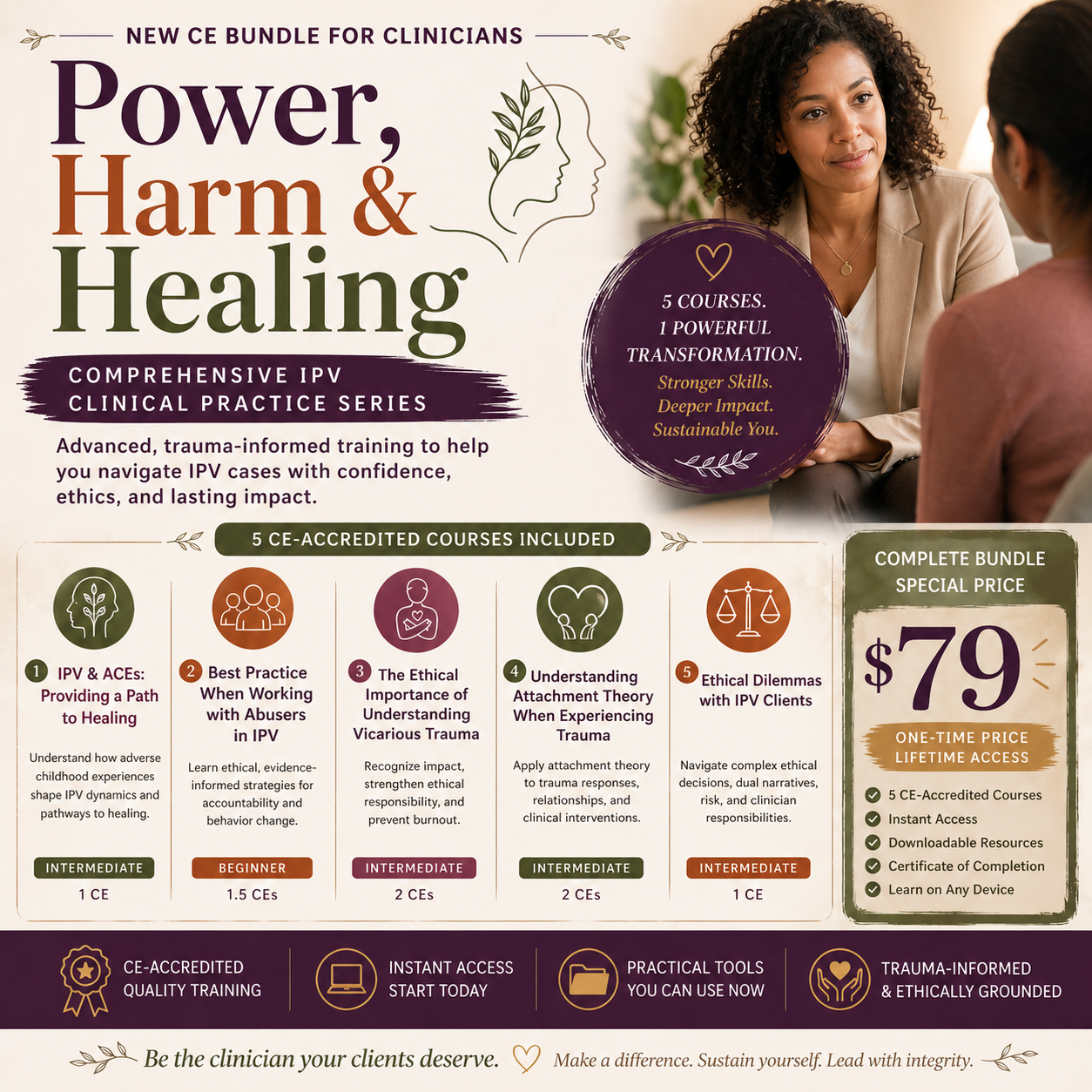
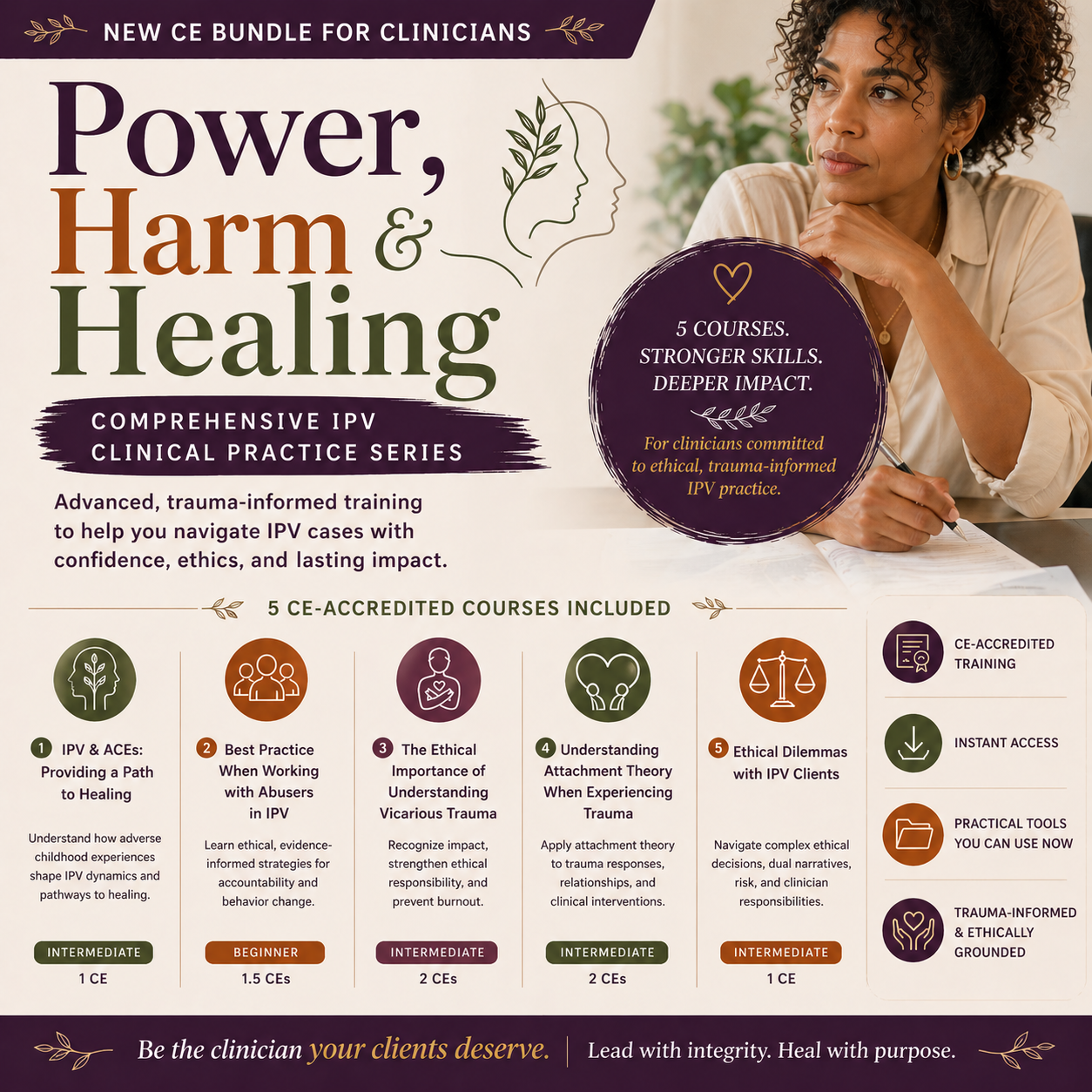
Intimate Partner Violence (IPV) & Adverse Childhood Experiences (ACEs): Providing a Path to Healing (Intermediate – 1 CE)
Understand the connection between early trauma and adult relationship dynamics
Identify how ACEs influence vulnerability, attachment, and behavior in IPV cases
Learn trauma-informed strategies to support long-term healing and disruption of cycles
🔥 Module 2: Accountability & Intervention
Best Practice When Working with Abusers in IPV (Beginner – 1.5 CEs)
Learn how to work with individuals who cause harm without minimizing responsibility
Explore accountability-based interventions that promote behavior change
Navigate resistance, denial, and manipulation with clinical clarity
🌿 Module 3: Attachment, Trauma & Healing
Understanding Attachment Theory When Experiencing Trauma (Intermediate – 2 CEs)
Explore how attachment styles shape trauma responses and relationships
Identify attachment patterns in IPV dynamics
Apply attachment-based interventions to support relational healing and safety
⚖️ Module 4: Ethical Dilemmas with IPV Clients (Intermediate – 1CE)
Analyze ethical dilemmas in IPV clinical practice using professional standards.
Assess and respond to dual narratives in IPV cases.
Apply ethical decision-making frameworks to clinical scenarios.
Evaluate risk and determine appropriate interventions in IPV cases.
Manage clinical uncertainty while maintaining ethical and professional responsibility.
💞 Module 5: Sustaining the Clinician
The Ethical Importance of Understanding Vicarious Trauma (Intermediate – 2 CEs)
Recognize the impact of vicarious trauma in IPV and trauma work
Learn ethical responsibilities around self-awareness and clinician care
Build strategies to prevent burnout and maintain longevity in your practice
🌍 Why This Training Matters
IPV is not just a clinical issue—it’s a social justice issue.
It lives at the intersection of:
Power
Oppression
Trauma
Culture
Identity
You cannot do this work effectively without understanding those layers.
This training equips you to:
✔ Disrupt cycles of harm
✔ Show up with cultural and ethical awareness
✔ Practice in a way that promotes real, lasting change
👑 This Series Is For You If…
You’re a therapist, social worker, or helping professional
You work (or want to work) with IPV cases
You’ve felt uncertain, overwhelmed, or underprepared
You want to strengthen your clinical skills and ethical decision-making
You’re ready to move from reactive → intentional → impactful
⚡ This Is Not Your Basic Training
This isn’t surface-level information you’ll forget next week.
This is:
Real-world application
Honest conversations about harm and responsibility
Frameworks you can immediately use in session
Training that challenges you to grow
Because your clients deserve more than guesswork.
And so do you.
💬 What Makes This Different?
These training centers:
Accountability without shame
Trauma-informed, culturally responsive care
Both survivor support and intervention with those who cause harm
Ethical practice in high-stakes situations
You’re not choosing sides.
You’re learning how to hold the full picture.
📜 What You’ll Walk Away With
A clear IPV clinical framework
Increased confidence in assessment and intervention
Tools to navigate complex ethical dilemmas
Strategies to support both safety and accountability
A deeper understanding of power, trauma, and relational dynamics
🚨 Stop Second-Guessing Yourself in IPV Cases
You don’t have to:
Wonder if you’re missing something
Feel stuck when clients present conflicting stories
Avoid addressing harm because it feels uncomfortable
You can become the clinician who:
sees clearly, responds ethically, and leads with confidence.
🌿 Your Next Step
Join Power, Harm & Healing: Comprehensive IPV Clinical Practice Series
Step into the kind of clinical work that is:
Grounded
Ethical
Transformational
👉 Enroll Now and Strengthen Your Clinical Practice
Because this work is too important to do without the right tools.
*All courses are ASWB Approved Continuing Education (ACE) and offered through an Approved Continuing Education Provider (ACEP), ensuring high-quality, trusted learning you can count toward your licensure requirements.




Reviews
There are no reviews yet.